
Bend#
Copyright © EDF 2002 - 2026#
ThermoSysPro Version 4.2#
This component model is documented in Sect. 13.6 of the ThermoSysPro book.
Bend#
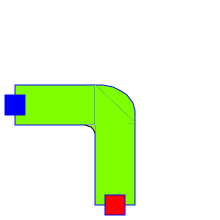
The bend models the singular pressure loss of a fluid circulating inside a bend pipe. For water/steam, the flow regime can be single-phase or homogeneous two-phase flow.
Following assumptions are made:
The flow inside pressure losses is adiabatic. Non-adiabatic pipes must be
modeled by connecting pressure losses to volumes.The specific enthalpy inside the components is equal to the specific enthalpy at the inlet.
The properties of the fluid are computed for the average pressure..
Inertia due to momentum inside pipes is neglected.
The friction pressure loss coefficient is calculated using the geometry of the bend. The bend thus completes the singular pressure loss component, in which the pressure loss coefficient is a single parameter.
Modelica component model#
The equations mentioned below are implemented in the component Bend, located in the WaterSteam.PressureLosses sub-library.
This component has 2 connectors:
C1: fluid inlet,
C2: fluid outlet.
Nomenclature#
Symbol |
Description |
Unit |
Definition |
Modelica name |
|---|---|---|---|---|
\(A_{1}\) |
Factor for the singular pressure loss coefficient |
\(-\) |
yA1 |
|
\(B_{1}\) |
Factor for the singular pressure loss coefficient |
\(-\) |
yB1 |
|
\(C_{1}\) |
Factor for the singular pressure loss coefficient |
\(-\) |
yC1 |
|
\(D\) |
Internal diameter of the bend |
\(\mathrm{m}\) |
D |
|
\(h\) |
Fluid specific enthalpy at the inlet |
\(\mathrm{J} / \mathrm{kg}\) |
h |
|
\(K_{\varepsilon}\) |
Roughness factor |
\(-\) |
kdelta |
|
\(\dot{m}\) |
Fluid mass flow rate |
\(\mathrm{kg} / \mathrm{s}\) |
Q |
|
\(P_{\mathrm{i}}\) |
Fluid pressure at the inlet |
\(\mathrm{Pa}\) |
C1.P |
|
\(P_{\mathrm{o}}\) |
Fluid pressure at the outlet |
\(\mathrm{Pa}\) |
C2.P |
|
\(R\) |
Bend radius |
\(\mathrm{m}\) |
R0 |
|
\(Re\) |
Reynolds number |
\(-\) |
\(\frac{4 \cdot \lvert \dot{m} \rvert}{\pi \cdot D \cdot \mu}\) |
Re |
\(Re_{\lim }\) |
limiting Reynolds number |
\(-\) |
Relim |
|
\(\delta\) |
Bend angle |
\(\circ\) |
delta |
|
\(\Delta P\) |
Pressure loss between the inlet and the outlet |
\(\mathrm{Pa}\) |
\(P_{\mathrm{i}}-P_{\mathrm{o}}\) |
deltaP |
\(\varepsilon\) |
Pipe roughness |
\(\mathrm{m}\) |
rugosrel |
|
\(\zeta\) |
Hydraulic pressure loss coefficient |
\(-\) |
khi |
|
\(\zeta_{m}\) |
singular pressure loss coefficient |
\(-\) |
khim |
|
\(\zeta_{f}\) |
Friction pressure loss coefficient |
\(-\) |
khif |
|
\(\lambda\) |
Friction pressure loss coefficient |
\(-\) |
lambda |
|
\(\mu\) |
Fluid dynamic viscosity |
\(\mathrm{Pa} \mathrm{s}\) |
mu |
|
\(\rho\) |
Fluid density |
\(\mathrm{kg} / \mathrm{m}^{3}\) |
rho |
Governing equations#
Static momentum balance equation#
Validity domain:
\(\forall \dot{m}\)
Mathematical formulation:
Comments:
Hydraulic pressure loss coefficient#
Validity domain:
\(\forall \dot{m}\) with \(Re>Re_{\lim }\)
Mathematical formulation:
Comments:
The limiting Reynolds number is given by:
References#
El Hefni, Baligh and Bouskela, Daniel (2019). Modeling and Simulation of Thermal Power Plants with ThermoSysPro, sect. 13.6. Springer Nature Switzerland AG.