
StaticDrum#
Copyright © EDF 2002 - 2026#
ThermoSysPro Version 4.2#
This component model is documented in Sect. 14.6 of the ThermoSysPro book.
Static drum#
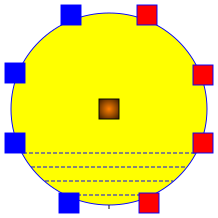
The static drum is a reservoir at the top end of the boiler. It separates water from steam in the mixture generated in the boiler and stores them.
This component can also be used as a simple steam generator.
The static drum is modeled according to the following assumptions:
heat exchanges between the liquid and steam phases, as well as between drum and external medium, are negligible,
pressure losses are negligible,
water is always saturated.
Modelica component model#
The equations mentioned below are implemented in the component StaticDrum, located in the WaterSteam.Junctions sub-library.
This component has 9 connectors:
Ce_eva: saturated water inlet from the evaporator,
Cs_eva: saturated water outlet toward the evaporator,
Ce_sup: supplementary water inlet,
Cs_sup: supplementary water outlet,
Ce_eco: water inlet from a money saver,
Ce_steam: steam inlet,
Cs_sur: saturated steam outlet toward the overheater,
Cs_purg: saturated water outlet toward the drain,
Cth: thermal port.
Nomenclature#
Symbol |
Description |
Unit |
Definition |
Modelica name |
|---|---|---|---|---|
\(h_{\text {eco, } i}\) |
Specific enthalpy of the liquid at the inlet of the drum, coming from the economizer |
\(\mathrm{J} / \mathrm{kg}\) |
Ce_eco.h |
|
\(h_{\text {eva }, \mathrm{i}}\) |
Specific enthalpy of the fluid at the inlet of the drum, coming from the evaporator |
\(\mathrm{J} / \mathrm{kg}\) |
Ce_eva.h |
|
\(h_{\text {steam }, \mathrm{i}}\) |
Specific enthalpy of the steam at the inlet |
\(\mathrm{J} / \mathrm{kg}\) |
Ce_steam.h |
|
\(h_{\text {sup }, \mathrm{i}}\) |
Specific enthalpy of the fluid at the additional inlet |
\(\mathrm{J} / \mathrm{kg}\) |
Ce_sup.h |
|
\(h_{\text {drain,o }}\) |
Specific enthalpy of the liquid at the outlet, going to the drain |
\(\mathrm{J} / \mathrm{kg}\) |
Cs_purg.h |
|
\(h_{\mathrm{eva}, \mathrm{o}}\) |
Specific enthalpy of the fluid at the outlet, going to the evaporator |
\(\mathrm{J} / \mathrm{kg}\) |
Cs_eva.h |
|
\(h_{\mathrm{sup}, \mathrm{o}}\) |
Specific enthalpy of the liquid at the additional outlet |
\(\mathrm{J} / \mathrm{kg}\) |
Cs_sup.h |
|
\(h_{\mathrm{sur}, \mathrm{o}}\) |
Specific enthalpy of the steam at the outlet, going to the super-heater |
\(\mathrm{J} / \mathrm{kg}\) |
Cs_sur.h |
|
\(\dot{m}_{\text {drain }, \mathrm{o}}\) |
Mass flow rate of the liquid at the outlet, going to the drain |
\(\mathrm{kg} / \mathrm{s}\) |
Cs_purg.Q |
|
\(\dot{m}_{\mathrm{eco}, \mathrm{i}}\) |
Mass flow rate of the fluid at the inlet, coming from the economizer |
\(\mathrm{kg} / \mathrm{s}\) |
Ce_eco.Q |
|
\(\dot{m}_{\text {eva }, \mathrm{i}}\) |
Mass flow rate of the fluid at the inlet, coming from the evaporator |
\(\mathrm{kg} / \mathrm{s}\) |
Ce_eva.Q |
|
\(\dot{m}_{\mathrm{eva}, \mathrm{o}}\) |
Mass flow rate of the liquid at the outlet, going to the evaporator |
\(\mathrm{kg} / \mathrm{s}\) |
Cs_eva.Q |
|
\(\dot{m}_{\text {steam, } \mathrm{i}}\) |
Mass flow rate of the steam at the inlet |
\(\mathrm{kg} / \mathrm{s}\) |
Ce_steam.Q |
|
\(\dot{m}_{\mathrm{sup}, \mathrm{i}}\) |
Mass flow rate of the fluid at the additional inlet |
\(\mathrm{kg} / \mathrm{s}\) |
Ce_sup.Q |
|
\(\dot{m}_{\mathrm{sup}, \mathrm{o}}\) |
Mass flow rate of the liquid at the additional outlet |
\(\mathrm{kg} / \mathrm{s}\) |
Cs_sup.Q |
|
\(m_{\mathrm{sur}, \mathrm{o}}\) |
Mass flow rate of the steam at the outlet, going to the super-heater |
\(\mathrm{kg} / \mathrm{s}\) |
Cs_sur.Q |
|
\(W\) |
Thermal power exchanged from the heat source to the fluid |
\(\mathrm{W}\) |
Cth.W |
|
\(x\) |
Steam mass fraction at the outlet going to the super-heater (steam separation efficiency) |
\(-\) |
x |
Governing equations#
Static mass balance equation#
Validity domain:
\(\forall \dot{m}\)
Mathematical formulation:
Comments:
Static energy balance equation#
Validity domain:
\(\exists \dot{m}\) such that \(\dot{m} \neq 0\)
Mathematical formulation:
Comments:
This equation is valid if some mass flow rates are non-zero. Otherwise, the mixing specific enthalpy is undefined.
Specific enthalpy at the drum liquid outlets#
Validity domain:
\(\exists \dot{m}\) such that \(\dot{m} \neq 0\)
Mathematical formulation:
Comments:
The liquid inside the drum is assumed always at saturation.
Specific enthalpy at the drum vapor outlet#
Validity domain:
\(\exists \dot{m}\) such that \(\dot{m} \neq 0\) and \(x \approx 1\)
Mathematical formulation:
Comments:
The vapor inside the drum is assumed always at saturation with possibly small amounts of water.
References#
El Hefni, Baligh and Bouskela, Daniel (2019). Modeling and Simulation of Thermal Power Plants with ThermoSysPro, sect. 14.6. Springer Nature Switzerland AG.