
FossilFuelBoiler#
Copyright © EDF 2002 - 2026#
ThermoSysPro Version 4.2#
This component model is documented in Sect. 7.2 of the ThermoSysPro book.
Fossil fuel boiler#
The boiler is the most complex subsystem of a power plant.
It is split into a pair of interacting circuits: the water/steam circuit and the flue gases circuit.
There are different components present in flue gases and water/steam circuits: boiler furnace with membrane water-walls, heat exchangers, drums, headers, volumes, mixers, splitters, and valves.
Modelica component model#
The equations mentioned below are implemented in the component FossilFuelBoiler, located in the MultiFluids.Boilers sub-library.
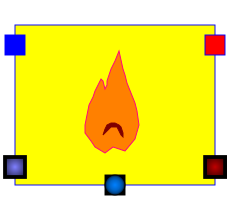
The component has 5 connectors:
Cws1: water/steam flow at the inlet,
Cws2: water/steam flow at the outlet,
Cair: air at the inlet,
Cfuel: fuel at the inlet,
Cfg: flue gases at the outlet.
Nomenclature#
Symbol |
Description |
Unit |
Definition |
Modelica name |
|---|---|---|---|---|
\( c_{p, f} \) |
Fuel specific heat capacity |
\( \mathrm{J/kg/K} \) |
Cpcomb |
|
\(E_x \) |
Dry air stoichiometry necessary for 1kg fuel combustion |
- |
Proportion of oxygen in the air at the inlet required to burn 1kg of fuel |
- |
\(E_{X,a} \) |
Excess air |
\(\% \) |
\( 100 \cdot \left( \frac{\dot{m}_a \cdot (1 - X_{h_2O, a})}{\dot{m}_f \cdot E_X} - 1 \right) \) |
exc_air |
\( h_{a, i} \) |
Air specific enthalpy at the inlet |
\(\mathrm{J/kg} \) |
Hea |
|
\(\tilde{h}_{a, r} \) |
Air reference specific enthalpy |
\(\mathrm{J/kg} \) |
\(2501569 \cdot X_{h_2O, a} \) |
Hrair |
\( h_{f} \) |
Fuel specific enthalpy at the inlet |
\(\mathrm{J/kg} \) |
\(c_{p, f} \cdot (T_f - 273.16) \) |
Hcomb |
\( \tilde{h}_{f, r} \) |
Fuel reference specific enthalpy |
\(\mathrm{J/kg} \) |
0 |
Hrcomb |
\( h_{g} \) |
Flue gases specific enthalpy after combustion |
\(\mathrm{J/kg} \) |
Hf |
|
\( h_{g, o} \) |
Flue gases specific enthalpy at the outlet |
\(\mathrm{J/kg} \) |
Hsf |
|
\( \tilde{h}_{g, r} \) |
Flue gases reference specific enthalpy |
\(\mathrm{J/kg} \) |
\(2501569 \cdot X_{h_2O, g} \) |
Hrfum |
\( h_{ws, i} \) |
Water/steam specific enthalpy at the inlet |
\(\mathrm{J/kg} \) |
Hee |
|
\( h_{ws, o} \) |
Water/steam specific enthalpy at the outlet |
\(\mathrm{J/kg} \) |
Hse |
|
LHV |
Fuel lower heating value |
\(\mathrm{J/kg} \) |
Cfuel.LHV |
|
\(\dot{m}_a \) |
Air mass flow rate |
\(\mathrm{kg/s} \) |
Qea |
|
\(\dot{m}_f \) |
Fuel mass flow rate |
\(\mathrm{kg/s} \) |
Qcomb |
|
\(\dot{m}_g \) |
Flue gases mass flow rate |
\(\mathrm{kg/s} \) |
Qsf |
|
\(\dot{m}_{ws} \) |
Water/steam mass flow rate |
\(\mathrm{kg/s} \) |
Qe |
|
\( M_C \) |
Carbon atomic mass |
\(\mathrm{kg/kmol} \) |
12.01115 |
amC |
\( M_H \) |
Hydrogen atomic mass |
\(\mathrm{kg/kmol} \) |
1.00797 |
amH |
\( M_O \) |
Oxygen atomic mass |
\(\mathrm{kg/kmol} \) |
15.9994 |
amO |
\( M_S \) |
Sulfur atomic mass |
\(\mathrm{kg/kmol} \) |
32.064 |
amS |
\( M_{CO_2} \) |
\(CO_2\) molar mass |
\(\mathrm{kg/kmol} \) |
\(M_C + 2 \cdot M_O \) |
amCO2 |
\( M_{H_2O} \) |
\(H_2O\) molar mass |
\(\mathrm{kg/kmol} \) |
\(M_O + 2 \cdot M_H \) |
amH2O |
\( M_{SO_2} \) |
\(SO_2\) molar mass |
\(\mathrm{kg/kmol} \) |
\(M_S + 2 \cdot M_O \) |
amSO2 |
\( P_{g,i} \) |
Air pressure at the inlet |
\(\mathrm{Pa} \) |
Pea |
|
\( P_{g,o} \) |
Flue gases pressure at the outlet |
\(\mathrm{Pa} \) |
Psf |
|
\( P_{ws,i} \) |
Water/steam pressure at the inlet |
\(\mathrm{Pa} \) |
Pee |
|
\( P_{ws,o} \) |
Water/steam pressure at the outlet |
\(\mathrm{Pa} \) |
Pse |
|
\( T_{a,i} \) |
Air temperature at the inlet |
\(\mathrm{K} \) |
Tea |
|
\( T_{f} \) |
Fuel temperature at the inlet |
\(\mathrm{K} \) |
Tcomb |
|
\( T_{g,o} \) |
Flue gases temperature at the outlet |
\(\mathrm{K} \) |
Cfg.T |
|
\( T_{g} \) |
Flue gases temperature after combustion |
\(\mathrm{K} \) |
Tf |
|
\( W_l \) |
Thermal losses |
\(\mathrm{W} \) |
Wloss |
|
\( X_{C,f} \) |
Carbon mass fraction in the fuel |
\(\mathrm{-} \) |
XCcomb |
|
\( X_{H,f} \) |
Hydrogen mass fraction in the fuel |
\(\mathrm{-} \) |
XHcomb |
|
\( X_{O,f} \) |
Oxygen mass fraction in the fuel |
\(\mathrm{-} \) |
XOcomb |
|
\( X_{S,f} \) |
Sulfur mass fraction in the fuel |
\(\mathrm{-} \) |
XScomb |
|
\( X_{CO_2,a} \) |
\( CO_2 \) mass fraction in the air at the inlet |
\(\mathrm{-} \) |
XeaCO2 |
|
\( X_{CO_2,g} \) |
\( CO_2 \) mass fraction in the flue gases |
\(\mathrm{-} \) |
XsfCO2 |
|
\( X_{H_2O,a} \) |
\( H_2O \) mass fraction in the air at the inlet |
\(\mathrm{-} \) |
XeaH2O |
|
\( X_{H_2O,g} \) |
\( H_2O \) mass fraction in the flue gases |
\(\mathrm{-} \) |
XsfH2O |
|
\( X_{O_2,a} \) |
\( O_2 \) mass fraction in the air at the inlet |
\(\mathrm{-} \) |
XeaO2 |
|
\( X_{O_2,g} \) |
\( O_2 \) mass fraction in the flue gases |
\(\mathrm{-} \) |
XsfO2 |
|
\( \eta \) |
Boiler efficiency \( 0 < \eta \le 1 \) |
\(\mathrm{-} \) |
Net thermal power at the outlet divided by the total thermal power at the inlet |
eta_boil |
\( \eta_c \) |
Combustion efficiency \( 0 < \eta_c \le 1 \) |
\(\mathrm{-} \) |
Burnt fuel mass divided by the input fuel mass |
etacomb |
\( \Lambda_g \) |
Flue gases pressure loss coefficient |
\(\mathrm{m}^{-4} \) |
Kf |
|
\( \Lambda_{ws} \) |
Water/steam pressure loss coefficient |
\(\mathrm{m}^{-4} \) |
Ke |
|
\( \rho_g \) |
Flue gases density |
\(\mathrm{kg/m}^3 \) |
rhof |
|
\( \rho_{ws} \) |
Water/steam density |
\(\mathrm{kg/m}^3 \) |
rhoe |
Governing equations#
The FossilFuelBoiler model is based on the energy and momentum balance equations.
This set of equations must be completed by the state equations involving \( h_{a,i}, \, h_{g,o}, \, T_g, \, \rho_g \; \text{and} \; \rho_{ws} \).
Mass balance equation for the flue gases#
Validity domain:
\( \forall \dot{m}_g \, , \dot{m}_a \; \text{and} \; \dot{m}_f \)
Mathematical formulation:
Comments:
Flue gases result from the combustion of fuel with air. If the combustion is not perfect (i.e. \( \eta_c < 1 \) ), there is unburnt fuel in the exhaust flue gases.
Energy balance equation for the flue gases#
Validity domain:
\( \forall \dot{m}_a \, , \dot{m}_f \; \text{and} \; \dot{m}_g>0 \)
Mathematical formulation:
Comments:
This equation is used to compute the flue gases specific enthalpy after combustion \( h_g \).
The combustion efficiency \(\eta_c \) and the fuel lower heating value LHV are model inputs.
The specific enthalpies \( h_f \) and \( h_{a,i} \) are computed using properties tables from the known temperatures \(T_f \) and \(T_{a,i} \).
Power exchanged in the boiler between flue gases and water/steam circuits#
Validity domain:
\( \forall \dot{m}_g \, , \dot{m}_a \, , \dot{m}_f \; \text{and} \;\ \dot{m}_{ws} \neq 0 \)
Mathematical formulation:
Comments:
This equation computes the water/steam specific enthalpy at the outlet \( h_{ws,o} \).
Boiler efficiency#
Validity domain:
\( \dot{m}_a > 0 \; \text{and} \;\ \dot{m}_f > 0 \)
Mathematical formulation:
Comments:
Another possible definition for the efficiency only takes into account the fuel LHV:
Momentum balance equation for the flue gases#
Validity domain:
\( \forall \dot{m}_f \)
Mathematical formulation:
Comments:
Momentum balance equation for the water/steam#
Validity domain:
\( \dot{m}_a > 0 \; \text{and} \;\ \dot{m}_f > 0 \)
Mathematical formulation:
Comments:
Dry air stoichiometry for the combustion of 1 kg fuel#
Validity domain:
\( X_{H_20,a} < 1 \; \text{and} \;\ X_{O_2,a} > 0 \)
Mathematical formulation:
Comments:
This formulation arises from the chemical reactions considered in the combustion:
\( C + O_2 \longrightarrow CO_2 \)
\( H + \frac{1}{4} 0_2 \longrightarrow H_2O \)
\( S + O_2 \longrightarrow SO_2 \)
\( CO_2 \) mass fraction in the flue gases#
Validity domain:
\( \dot{m}_g \neq 0 \)
Mathematical formulation:
Comments:
This formulation arises from the chemical reaction considered in the combustion:
\( H_2O \) mass fraction in the flue gases#
Validity domain:
\( \dot{m}_g \neq 0 \)
Mathematical formulation:
Comments:
This formulation arises from the chemical reaction considered in the combustion:
\( O_2 \) mass fraction in the flue gases#
Validity domain:
\( \dot{m}_g \neq 0 \)
Mathematical formulation:
Comments:
This formulation arises from the three chemical reactions mentioned in the dry air stoichiometry equation.
\( SO_2 \) mass fraction in the flue gases#
Validity domain:
\( \dot{m}_g \neq 0 \)
Mathematical formulation:
Comments:
This formulation arises from the three chemical reactions mentioned in the dry air stoichiometry equation.
References#
El Hefni, Baligh and Bouskela, Daniel (2019). Modeling and Simulation of Thermal Power Plants with ThermoSysPro. Springer Nature Switzerland AG.
El Hefni, Baligh and Bouskela, Daniel (2019). Modeling and Simulation of Thermal Power Plants with ThermoSysPro, sect. 7.2. Springer Nature Switzerland AG.