
StodolaTurbine#
Copyright © EDF 2002 - 2026#
ThermoSysPro Version 4.2#
This component model is documented in Sect. 10.2 of the ThermoSysPro book.
Stodola turbine#
The steam turbine transforms the steam thermal energy into mechanical energy
following the Rankine cycle. A multistage turbine is composed of a group of
stages that uses wet or dry steam.
The Stodola turbine is a quasi-static model, composed of a multistage steam turbine and a nozzle. Stodola’s cone law is used to compute the dependence of extraction pressures with the fluid flow.
The following assumptions are made:
the fluid speed is subsonic.
the dynamic response of the turbine is faster than the network queries (inertia is neglected).
the flow is supercritical or subcritical at the inlet and outlet.
Modelica component model#
The equations mentioned below are implemented in the component StodolaTurbine, located in the WaterSteam.HeatExchangers sub-library.
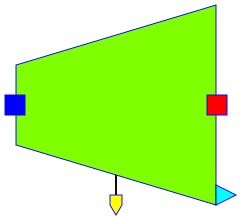
This component has 4 connectors:
Ce: fluid inlet,
Cs: fluid outlet,
M: mechanical torque,
P: mechanical power.
Nomenclature#
Symbol |
Description |
Unit |
Definition |
Modelica name |
|---|---|---|---|---|
\(A_{\mathrm{nz}}\) |
Nozzle area |
\(\mathrm{m}^{2}\) |
- |
|
\(C_{\mathrm{s}}\) |
Stodola’s ellipse coefficient |
\(-\) |
Cst |
|
\(h_{\mathrm{i}}\) |
Fluid specific enthalpy at the inlet |
\(\mathrm{J} / \mathrm{kg}\) |
Ce.h |
|
\(h_{\mathrm{is}}\) |
Fluid specific enthalpy after isentropic expansion |
\(\mathrm{J} / \mathrm{kg}\) |
His |
|
\(h_{\mathrm{o}}\) |
Fluid specific enthalpy at the outlet |
\(\mathrm{J} / \mathrm{kg}\) |
Cs.h |
|
\(m\) |
Fluid mass flow rate |
\(\mathrm{kg} / \mathrm{s}\) |
Q |
|
\(P_{\mathrm{i}}\) |
Fluid pressure at the inlet |
\(\mathrm{Pa}\) |
Pe |
|
\(P_{\mathrm{o}}\) |
Fluid pressure at the outlet |
\(\mathrm{Pa}\) |
Ps |
|
\(T_{\mathrm{i}}\) |
Fluid temperature at the inlet |
\(\mathrm{K}\) |
Te |
|
\(v_{\mathrm{o}}\) |
Fluid velocity at the outlet |
\(\mathrm{m} / \mathrm{s}\) |
\(\frac{\dot{m}}{\rho_{\mathrm{o}} \cdot A_{\mathrm{nz}}}\) |
Ts |
\(W\) |
Mechanical power produced by the turbine |
\(\mathrm{W}\) |
W |
|
\(W_{\text {fric }}\) |
Power losses due to hydrodynamic friction |
\(\%\) |
W_fric |
|
\(x_{\mathrm{i}}\) |
Vapor mass fraction at the inlet |
\(-\) |
proe.x |
|
\(x_{\mathrm{o}}\) |
Vapor mass fraction at the outlet |
\(-\) |
pros.x |
|
\(\eta_{\mathrm{is}}\) |
Isentropic efficiency for the dry steam |
\(-\) |
eta_is |
|
\(\eta_{\mathrm{is}}^{\mathrm{wet}}\) |
Isentropic efficiency for wet steam |
\(-\) |
eta_is_wet |
|
\(\eta_{\mathrm{nz}}\) |
Nozzle efficiency |
\(-\) |
eta_nz |
|
\(\eta_{\mathrm{sta}}\) |
Efficiency to account for kinetic losses |
\(-\) |
eta_stato |
Governing equations#
Stodola’s ellipse law mass flow rate for subcritical flow#
Validity domain:
\(\forall \dot{m}\) and \(x_{\mathrm{i}}>0\)
Mathematical formulation:
Comments:
Stodola’s ellipse law mass flow rate for supercritical flow#
Validity domain:
\(\forall \dot{m}\)
Mathematical formulation:
Comments:
Fluid specific enthalpy at the outlet#
Validity domain:
everywhere
Mathematical formulation:
Comments:
The last term of the equation corresponds to the kinetic energy of the steam at the outlet. The nozzle efficiency \(\eta_{\mathrm{nz}}\) is less than unity for a turbine with nozzle and equal to unity for a turbine without nozzle.
Energy balance equation (mechanical power produced by the turbine)#
Validity domain:
\(\forall \dot{m}\)
Mathematical formulation:
References#
El Hefni, Baligh and Bouskela, Daniel (2019). Modeling and Simulation of Thermal Power Plants with ThermoSysPro, sect. 10.2. Springer Nature Switzerland AG.