Warped Calendar Harmonics
Navigation:
Theory introduction: See the Intro
Related code architecture: See the Code Architecture
Diffeomorphic Phase-Warped Calendar Harmonics
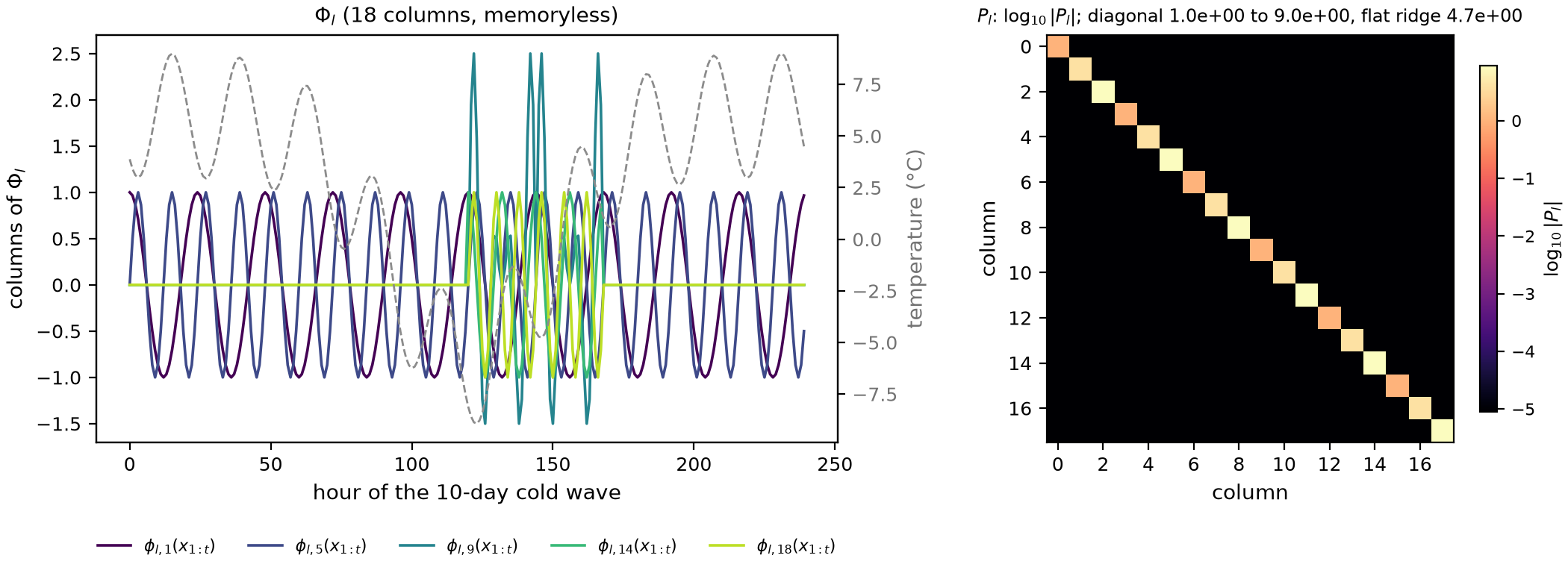
During regime shifts (e.g., weekends, public holidays, or school breaks) indicated by \(z_t \in \{0, 1\}\), periodic daily or annual profiles undergo both vertical amplitude scaling and horizontal phase shifts. Given base Fourier harmonics \(\Phi_{\text{base}}(\tau_t) = [\cos(k \tau_t), \sin(k \tau_t)]_{k=1}^K\) on phase \(\tau_t \in [0, 2\pi)\), a non-collinear second-order phase-modulation envelope \(g(\tau_t) = (\tau_t - \pi)/\pi \in [-1, 1)\) produces full-rank \(6K\) columns:
regularized by a block-diagonal Sobolev frequency penalty \(P_{\text{wcal}} = \lambda \cdot \operatorname{blkdiag}(P_{\text{base}}, \gamma_{\text{warp}} P_{\text{base}}, \gamma_{\text{amp}} P_{\text{base}})\) with weights \(k^s\).
Grouped models
When the model is grouped by the column that wcal reads (for example group_col='tod' with wcal(tod, ...)), that column is constant inside each group. The base harmonic columns are then constant, and the remaining columns vary only through by, so they add nothing that a day-type term on the same by column does not already span. Use wcal in a model that is not grouped by its input column.
Normalized phase
Inside a model the input column is normalized to \([-1, 1]\) with the fixed range \((0, \text{period})\) (the effect is exempt from the training min/max normalization), so the phase of a step is \(\tau_t = \pi\,(x_t + 1) = 2\pi\,(\text{value}\bmod\text{period})/\text{period}\) and the envelope \(g(\tau_t) = (\tau_t - \pi)/\pi\) equals the normalized input \(x_t\) itself. A value outside the period wraps around it (extrapolate='periodic'): \(x \mapsto ((x + 1) \bmod 2) - 1\) for the values outside \([-1, 1]\).
Penalty coordinates
With a regime indicator the effect has three smoothing weights, one per block (base harmonics, warp, amplitude), starting at \(\lambda\), \(\gamma_{\text{warp}}\lambda\) and \(\gamma_{\text{amp}}\lambda\); without one it has a single weight:
Causality
The columns are a pointwise function of the phase and of the regime indicator: no memory, no state, no interaction between groups.
What is new here
Phase registration and amplitude scaling of calendar profiles are classical in functional data analysis [Ramsay and Silverman, 2005]. What this effect adds:
the first-order linearization of a phase warp as regressors of an additive model: the columns \(z_t\,g(\tau_t)\,\partial_\tau\Phi_{\text{base}}\) make a holiday shift of the daily profile linear in its coefficients;
the phase-modulation envelope \(g(\tau) = (\tau - \pi)/\pi\), which removes the exact collinearity between the warp and the amplitude blocks and keeps the \(6K\) columns of full rank;
one smoothing parameter per block, chosen by GCV or REML.
References
Ramsay, James O, Silverman, Bernard W (2005). Functional Data Analysis. Springer.
ramsay2005functionalGoude, Yannig, Nedellec, Raphael, Kong, Nicolas (2014). Local short and middle term electricity load forecasting with semi-parametric additive models. IEEE Transactions on Smart Grid.
goude2014localWood, Simon N (2017). Generalized additive models: an introduction with R. chapman and hall/CRC.
wood2017generalized