Causal Patch Basis
Navigation:
Theory introduction: See the Intro
Related code architecture: See the Code Architecture
Patch tokens with causal instance statistics
For each step \(t\) the patch is the last \(P\) values of the primary series, \(p_t = (x_{t-P+1}, \dots, x_t)\). Its own mean and standard deviation \((\hat\mu_t, \hat\sigma_t)\), computed on the patch only, remove the local level and scale (reversible instance normalization [Kim et al., 2022]):
The normalized patch is projected on \(M\) fixed orthogonal directions with a random phase, a random-feature map of a Gaussian kernel on patches [Rahimi and Recht, 2007], in the spirit of patch tokens of long-horizon forecasters [Nie et al., 2023]:
where the rows \(w_m\) are orthonormalized and scaled by \(1.5/\sqrt{P}\) and \(b_m \sim \mathcal{U}(0, 2\pi)\) (a seeded draw). Two more columns give the level and the scale that the normalization removed: \(\tanh(\hat\mu_t/4)\) and \(\tanh(\tfrac12\log\hat\sigma_t)\).
Lévy-area tokens
With \(D \ge 2\) channels, each pair \((a, b)\) contributes the antisymmetric Lévy area of the standardized patch paths \(u^{(a)}, u^{(b)}\),
the signed area enclosed by the pair of paths [Lyons, 1998], a measure of which channel leads. With one channel, the area between the path and its own one-step lag (rising versus falling loop) plays that role. The columns are \(M + 2 + n_{\text{levy}}\) in all.
Penalty
The ridge on a token is weighted by the roughness of its filter along the patch axis, \(1 + r_m / \bar r\) with \(r_m = \|D_2 w_m\|^2\) and \(\bar r\) the mean over tokens, so an oscillating filter costs more than a smooth one while the overall scale stays that of a ridge; the level, scale and Lévy columns keep the plain ridge weight 1. With \(P < 3\) every weight is 1.
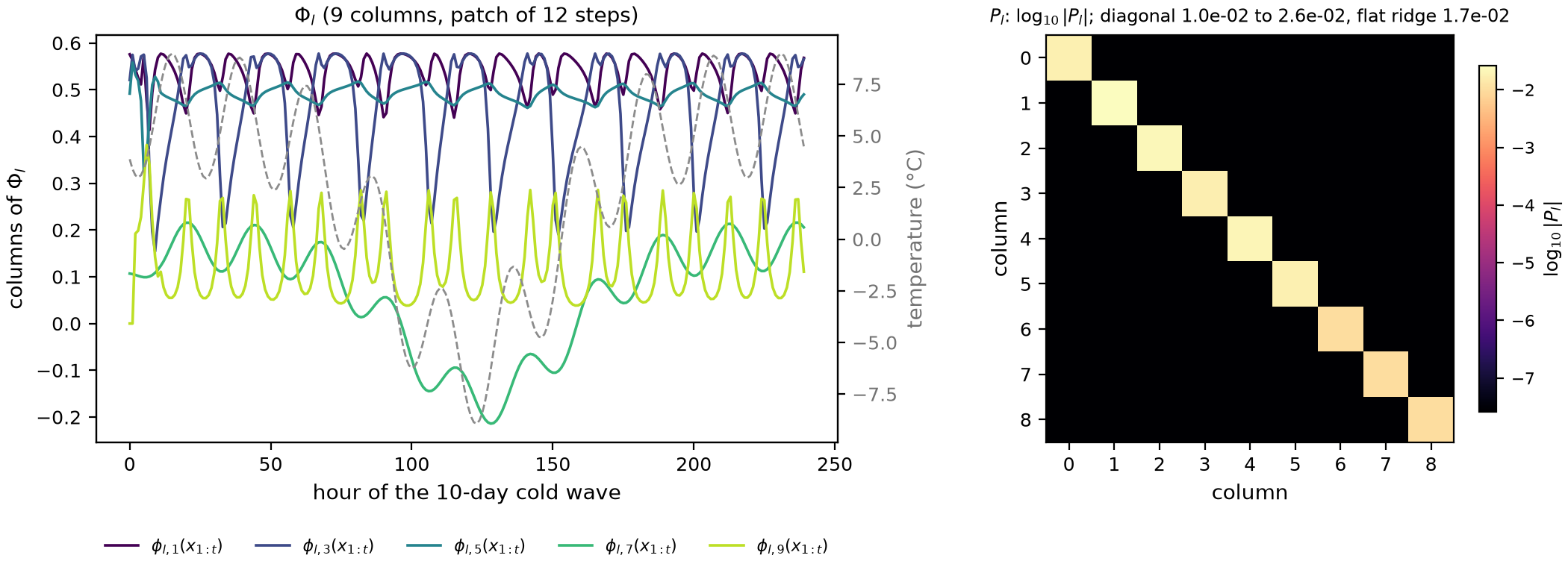
Causality and state continuation
A patch ends at the current step: the features of step \(t\) never use a later value, and the patches of different groups never overlap. The state is the last \(P - 1\) rows of each group, {"hist": (B, P - 1, D)}; without one the first row is replicated.
Chunk equivalence
The features of a series computed in one pass over it equal the features computed in two chunks when the second chunk starts from the terminal state of the first. Three mechanisms carry that state, and this effect uses a window history (the last rows of every group, which complete the windows of the next chunk) and frozen training statistics (constants estimated once on the training period, which a later chunk does not update). Because the state is exactly what a later row reads from the past, a forecast can continue a fitted series one chunk at a time without refitting or recomputing the past.
What is new here
The ingredients are those of the cited papers. What this effect adds:
causal patches with instance statistics computed on the patch itself, so that no statistic of the future or of the whole series enters a feature;
the fixed random-phase orthogonal tokens as a regression basis, solved by penalized weighted least squares with no trained weight;
the filter-roughness weighted penalty of the tokens;
the Lévy-area hysteresis tokens as regressors of an additive load model.
References
Kim, Taesung et al. (2022). Reversible Instance Normalization for Accurate Time-Series Forecasting against Distribution Shift. International Conference on Learning Representations (ICLR).
kim2022reversibleRahimi, Ali, Recht, Benjamin (2007). Random Features for Large-Scale Kernel Machines. Advances in Neural Information Processing Systems.
rahimi2007randomNie, Yuqi et al. (2023). A Time Series is Worth 64 Words: Long-term Forecasting with Transformers. International Conference on Learning Representations (ICLR).
nie2023timeLyons, Terry J (1998). Differential equations driven by rough signals. Revista Matematica Iberoamericana.
lyons1998differential