Hurst Fractional Gaussian Noise Basis
Navigation:
Theory introduction: See the Intro
Related code architecture: See the Code Architecture
Hurst Fractional Brownian Motion Penalty
For a long-memory process with Hurst exponent \(H \in (0, 1)\) ([Mandelbrot and Van Ness, 1968]), fractional Gaussian noise has power spectral density \(S_H(\omega) \propto |\omega|^{1 - 2H}\). The Hurst precision penalty matrix penalizes Fourier harmonics by the inverse power spectrum:
where \(j\) is the harmonic number (the \(m\) sine columns come first, then the \(m\) cosine columns); using \(j\) in place of \(|\omega_j|\) changes the weights by the constant factor \((2\pi/P)^{2H-1}\), which is absorbed in \(\lambda_p\).
\(H = 0.5\): Ordinary Brownian motion increments (white noise); penalty is flat isotropic Ridge (\(P \propto I\)).
\(H > 0.5\): Persistent long-memory dynamics; penalizes high frequencies (the exponent \(2H - 1\) is positive, so the weights \(j^{2H - 1}\) grow with \(j\)), forcing smooth persistent autocorrelation.
\(H < 0.5\): Anti-persistent, rough mean-reverting dynamics; relaxes high-frequency penalties, accommodating jagged sub-diffusive paths.
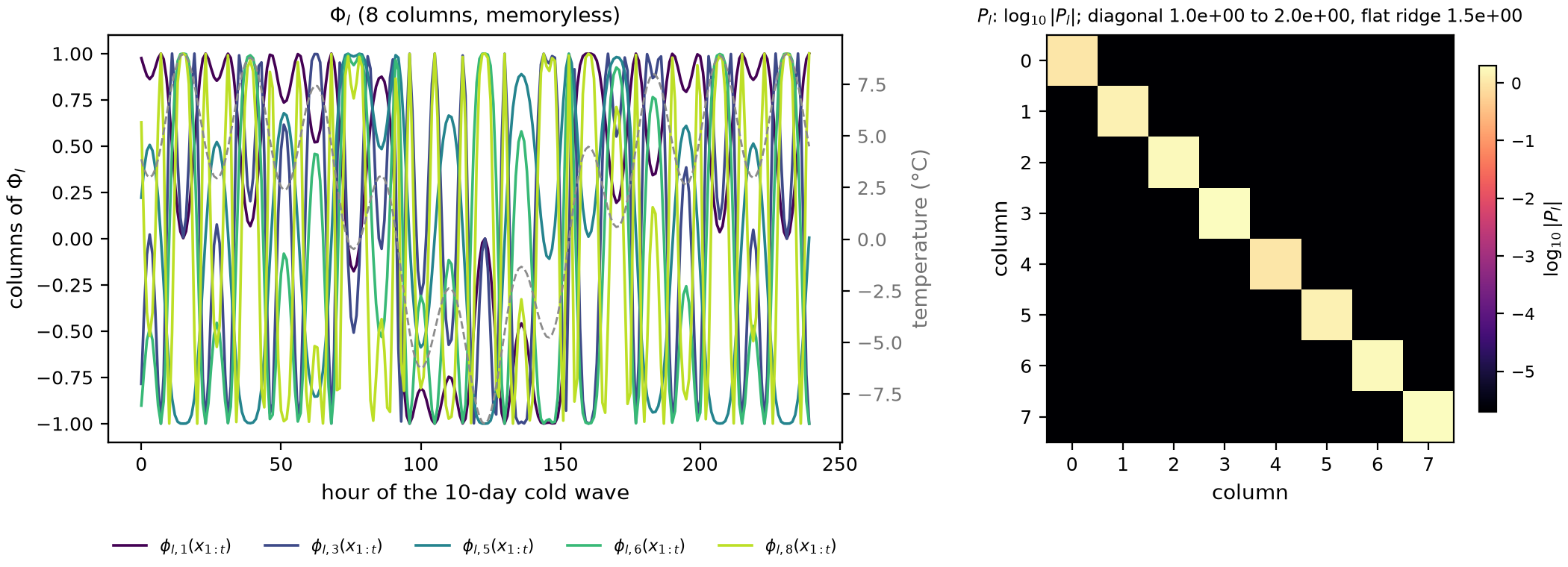
The basis
The columns are the harmonics of the value itself, \(\sin(2\pi j\,x/P)\) and \(\cos(2\pi j\,x/P)\) for \(j = 1, \dots, k/2\), with a period \(P\) equal to the span of the training values (or the given period). The effect is a pointwise function of the value: it has no memory and no state, and the groups do not interact. The span is frozen when the effect is initialized.
What this effect is not
The effect is a fixed fractional-smoothness prior, not an estimator of \(H\). The exponent is given and held in \([0.05, 0.95]\), and it acts on the pointwise harmonics of the covariate (functions of the value \(x\), not of the time index). It does not estimate a Hurst exponent from the data: it is neither detrended fluctuation analysis nor rescaled-range analysis, and the fitted coefficients say nothing about the long memory of a series. Reading \(H\) as a property of the load or of the covariate would be an error; it is one more smoothness knob of a penalized term.
What is new here
The fractional Gaussian noise spectrum is the one of the cited paper [Mandelbrot and Van Ness, 1968]. What this effect adds:
the long-memory spectral prior used as a smoothness penalty on a harmonic basis of a covariate: the exponent \(H\) chooses how fast the penalty grows with the harmonic, interpolating between a ridge (\(H = \tfrac12\)) and a smoothness-promoting penalty (\(H\) near 1), and is estimated nowhere: it is a modelling choice;
the penalty inside a closed-form penalized additive term with a smoothing parameter chosen by GCV or REML.
References
Mandelbrot, Benoit B, Van Ness, John W (1968). Fractional Brownian motions, fractional noises and applications. SIAM Review.
mandelbrot1968fractionalWood, Simon N (2017). Generalized additive models: an introduction with R. chapman and hall/CRC.
wood2017generalized