Smooth Degree-Day Hinges
Navigation:
Theory introduction: See the Intro
Related code architecture: See the Code Architecture
Smooth Softplus Heating & Cooling Degree-Day Hinges
Piecewise-linear heating and cooling degree-day thresholds \(\max(0, u_m - T_t)\) and \(\max(0, T_t - v_j)\) have discontinuous derivatives at the balance points \(u_m, v_j\). Replacing the hard hinge with a \(C^\infty\) softplus with sharpness \(\beta > 0\) yields:
Optionally, quadratic saturation terms \(\operatorname{HDD}_\beta^2\) and \(\operatorname{CDD}_\beta^2\) capture extreme cold or heat demand curvature under the penalty given below.
Penalty
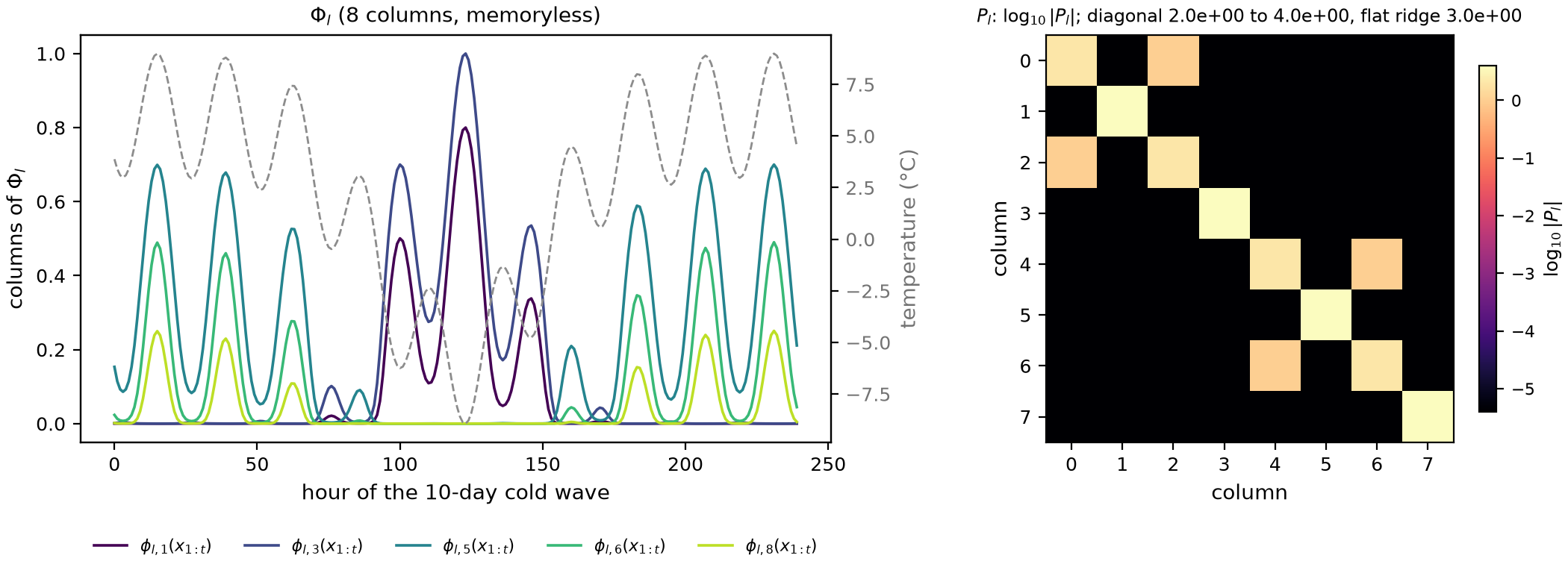
The columns are the hinges \(\operatorname{HDD}_\beta(\cdot; u_m)\) in ascending order of \(u_m\), then the hinges \(\operatorname{CDD}_\beta(\cdot; v_j)\) in ascending order of \(v_j\), each followed by its square when quad=True. A squared hinge grows faster than a hinge, so it weighs four times more. The hinges of one family, ordered by threshold, are coupled by a first difference, which prefers slopes that change slowly from one threshold to the next:
With a single threshold per side there is no coupling and the penalty is diagonal. The two families never mix.
Causality
The hinges are a pointwise function of the temperature: no memory, no state, no interaction between groups.
What is new here
Degree-day variables are a standard device of load forecasting [Goude et al., 2014]. What this effect adds:
the softplus hinge with a sharpness parameter [Dugas et al., 2000], differentiable at the balance point, so that the fitted response has no kink;
a family-wise difference penalty coupling neighbouring thresholds, so that a dictionary of several thresholds behaves like one smooth heating curve and one smooth cooling curve;
the quadratic hinges weighed by four, which keeps the curvature terms from taking over at the extremes of temperature.
The token smooth_hinge is the same effect under its generic name.
References
Goude, Yannig, Nedellec, Raphael, Kong, Nicolas (2014). Local short and middle term electricity load forecasting with semi-parametric additive models. IEEE Transactions on Smart Grid.
goude2014localDugas, Charles et al. (2000). Incorporating second-order functional knowledge for better option pricing. Advances in Neural Information Processing Systems (NIPS).
dugas2001incorporatingEilers, Paul HC, Marx, Brian D (1996). Flexible smoothing with B-splines and penalties. Statistical science.
eilers1996flexible