Kolmogorov-Arnold Network Edge Splines
Navigation:
Theory introduction: See the Intro
Related code architecture: See the Code Architecture
Kolmogorov–Arnold Network Edge Spline Basis
Theoretical foundation
By the Kolmogorov–Arnold Representation Theorem ([Kolmogorov, 1957]), any multivariate continuous function \(f: [0, 1]^d \to \mathbb{R}\) can be expressed as:
Following Liu et al. ([Liu et al., 2024]), inner edge functions \(\psi_{q,p}\) combine residual SiLU activation with univariate B-spline expansions:
Primal representation and penalty matrix
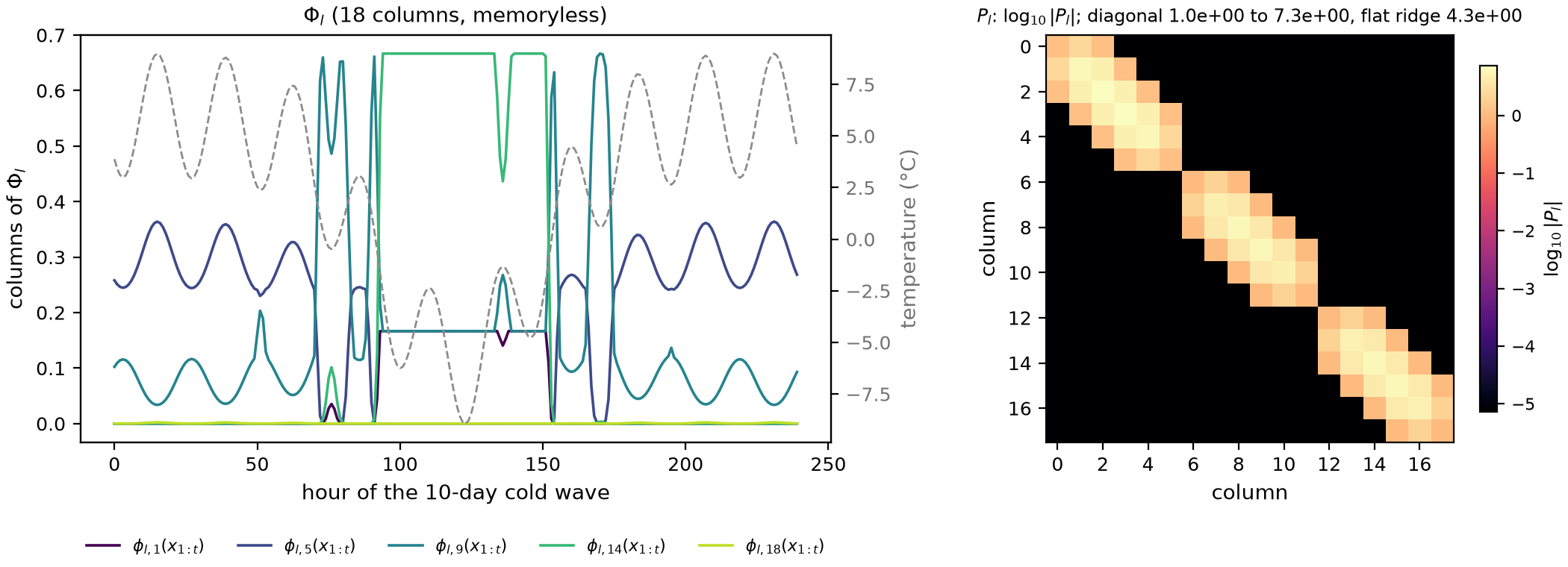
Given \(Q\) aggregation nodes \(z_{t,q} = \tanh\!\big(0.28\,(u_{t,q} - \hat\mu_q)/\hat\sigma_q\big)\) with \(u_{t,q} = \sum_{p=1}^d \psi_{q,p}(x_{t,p})\) (the centring and scaling are described below), outer B-splines evaluate:
The total Primal design matrix \(\Phi_{\text{kan}} \in \mathbb{R}^{T \times (Q \cdot k_{\text{out}})}\) is regularized by a block-diagonal second-difference Sobolev roughness penalty:
(the edge-roughness weight \(\mathcal{E}_q\) and the small ridge \(\varepsilon\) are described below).
reducing representation complexity from \(\mathcal{O}(k^d)\) to \(\mathcal{O}(Q d k)\) while representing exact product interactions \(x_1 x_2 = \frac{1}{4}(x_1+x_2)^2 - \frac{1}{4}(x_1-x_2)^2\).
Scale stabilization
The inner nodes \(u_{t,q} = \sum_p \psi_{q,p}(x_{t,p})\) are centered and scaled with their training mean and standard deviation before the saturating map, \(z_{t,q} = \tanh\!\big(0.28\,(u_{t,q} - \hat\mu_q)/\hat\sigma_q\big)\), so that the outer splines see values spread over \([-1, 1]\) whatever the scale of the inputs. The inner parameters \((w, c)\) are drawn once from a seeded generator in float64 and are not trained: the model stays linear in the outer coefficients \(\theta\) and is solved in closed form. The edge roughness \(\mathcal{E}_q\) of a node (second differences of its inner spline coefficients) multiplies the outer penalty of that node by \(1 + \alpha_{\text{edge}}\mathcal{E}_q\).
Causality and state
The effect reads one row at a time: it has no memory and no state, and a group never influences another. The standardization, the inner knots, the inner parameters and the node statistics are computed when the effect is initialized, on all the training rows, and frozen.
Ridge on the null space
Each node block of the penalty carries, besides the weighted second differences, a small ridge \(\varepsilon I\) with \(\varepsilon = 10^{-6}\): \(P_{\text{kan}} = \operatorname{blkdiag}_q\big((1 + \alpha_{\text{edge}}\mathcal{E}_q) D^\top D + \varepsilon I\big)\lambda_p\). The second-difference operator \(D\) has the straight lines in its null space, so without the ridge the penalty is only positive semi-definite; with it the penalty is positive definite, and the log-determinant of the penalty that the restricted marginal likelihood uses is defined.
What is new here
The representation theorem and the edge-spline network are the ones of the cited papers [Kolmogorov, 1957, Liu et al., 2024]. What this effect adds:
fixed random inner edges with an outer layer solved in closed form: the Kolmogorov–Arnold structure is used as a dimension-reducing feature map (\(Q\,k_{\text{out}}\) columns instead of \(k^d\)), not as a network trained by gradient descent;
the edge-roughness-weighted penalty that makes the node whose inner edges are rough more expensive to use;
the scale-stable node normalization before the saturating map, which keeps the outer splines in range for covariates of any unit.
References
Kolmogorov, Andrei Nikolaevich (1957). On the Representation of Continuous Functions of Many Variables by Superposition of Continuous Functions of One Variable and Addition. Doklady Akademii Nauk SSSR.
kolmogorov1957representationLiu, Ziming et al. (2024). KAN: Kolmogorov-Arnold Networks. arXiv preprint arXiv:2404.19756.
liu2024kanDe Boor, Carl (1978). A practical guide to splines. springer New York.
de1978practicalEilers, Paul HC, Marx, Brian D (1996). Flexible smoothing with B-splines and penalties. Statistical science.
eilers1996flexible