Quickstart#
Paper: TS-ICL: A Flexible Time-Indexed Foundation Model for Time Series via In-Context Learning
TS-ICL is a continuous probabilistic Time Series Foundation Model (TSFM) that unifies forecasting and imputation in a single zero-shot architecture, requiring no task-specific training or fine-tuning.
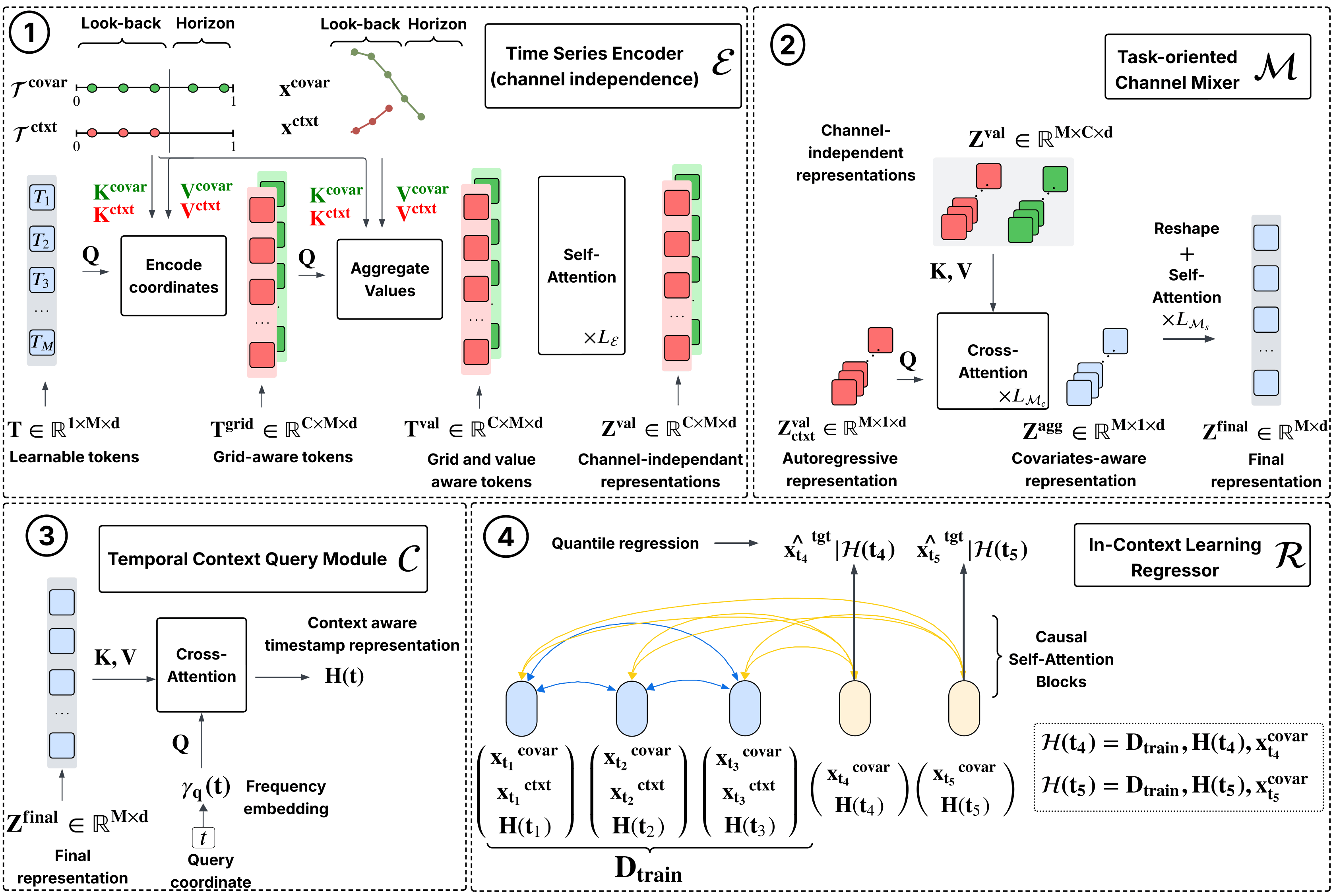
TS-ICL architecture#
Installation#
pip install tsicl
Model checkpoint can be found on TS-ICL’s Huggingface repo.
Requirements: Python ≥ 3.12, PyTorch ≥ 2.5.1
Quick Start#
from tsicl import TSICL

model = TSICL(model_path="checkpoints/tsicl-v1.ckpt")

# Forecasting — predict the next 96 timesteps
point, quantiles = model.forecast(
    inputs            = my_series,        # e.g. 1-D numpy array or tensor
    prediction_length = 96,
    quantile_levels   = [0.1, 0.5, 0.9],
    denormalize       = True
)

# Imputation — reconstruct NaN values
point, quantiles = model.impute(
    inputs          = my_series_with_nans,
    quantile_levels = [0.1, 0.5, 0.9],
    denormalize     = True
)
Both methods return a (point_prediction, quantile_predictions)
tuple. NaN values are handled natively — no preprocessing required.
Notebooks#
Step-by-step tutorials on synthetic Gaussian Processes:
Notebook |
Description |
|---|---|
Pointwise & block missingness, covariate-aware imputation, output format, batch processing |
|
Univariate forecasting, partially observed look-back, covariate-aware forecasting, batch processing |
Model#
TS-ICL processes each time series through four successive modules:
Time Series Encoder — a Perceiver-like architecture that compresses observed (timestamp, value) pairs into M = 32 learnable latent tokens via cross-attention. Accepts inputs of arbitrary length without preprocessing.
Channel Mixer — aggregates information across channels via cross-attention. Selectively integrates covariate representations into the target’s representation when covariates are provided.
Temporal Context Query Module — maps any query timestamp to a context-aware embedding using Fourier (NeRF-style) positional encoding. Enables prediction at arbitrary timestamps, including on irregular grids.
In-Context Regressor — a causal Transformer that reads observed (representation, value) pairs as in-context training examples and outputs 99 quantiles at the queried timestamps.
A single checkpoint (tsicl-v1.ckpt) contains two specialised
components — one trained with masking for imputation, one with causal
masking for forecasting — sharing the same architecture backbone.
Performance#
Forecasting — fev-bench#
TS-ICL is highly competitive with the best forecasting foundation models, while being fast at inference. TS-ICL efficently leverages covariate (when relevant) and is also robust to sparse look-back windows.
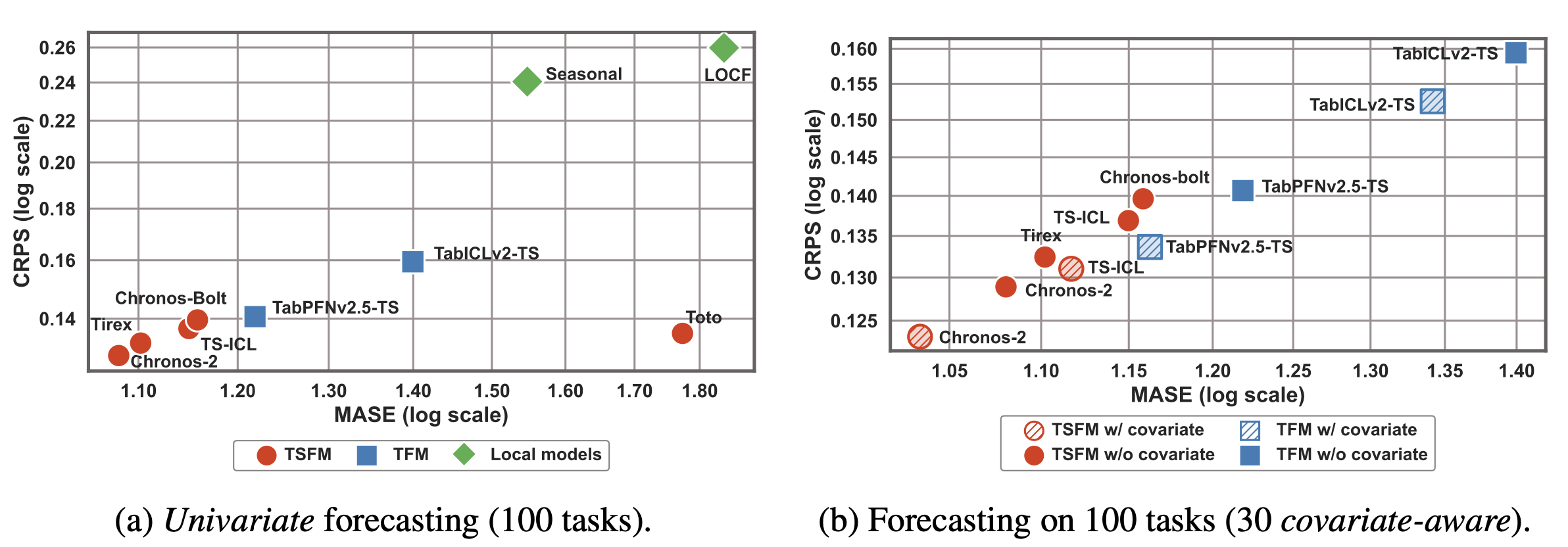
fev-bench results#
Example — pointwise forecast with a known covariate (GFC17 dataset):
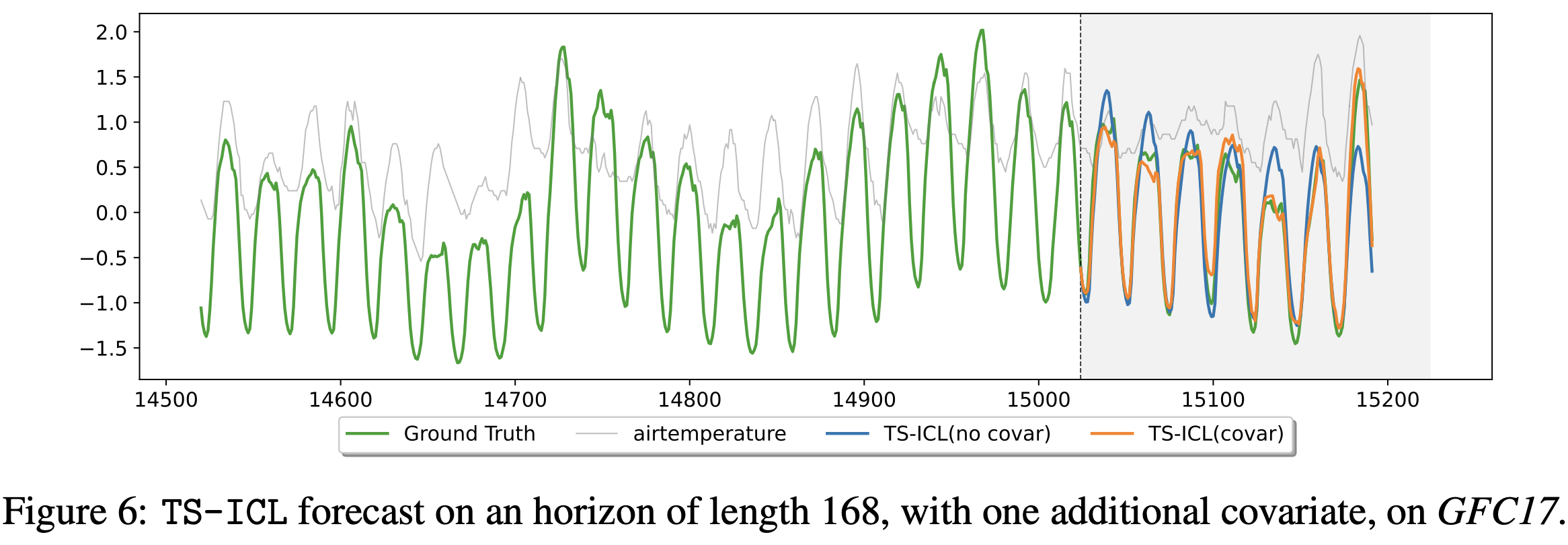
Forecast with covariate example#
Forecasting — TIME benchmark#
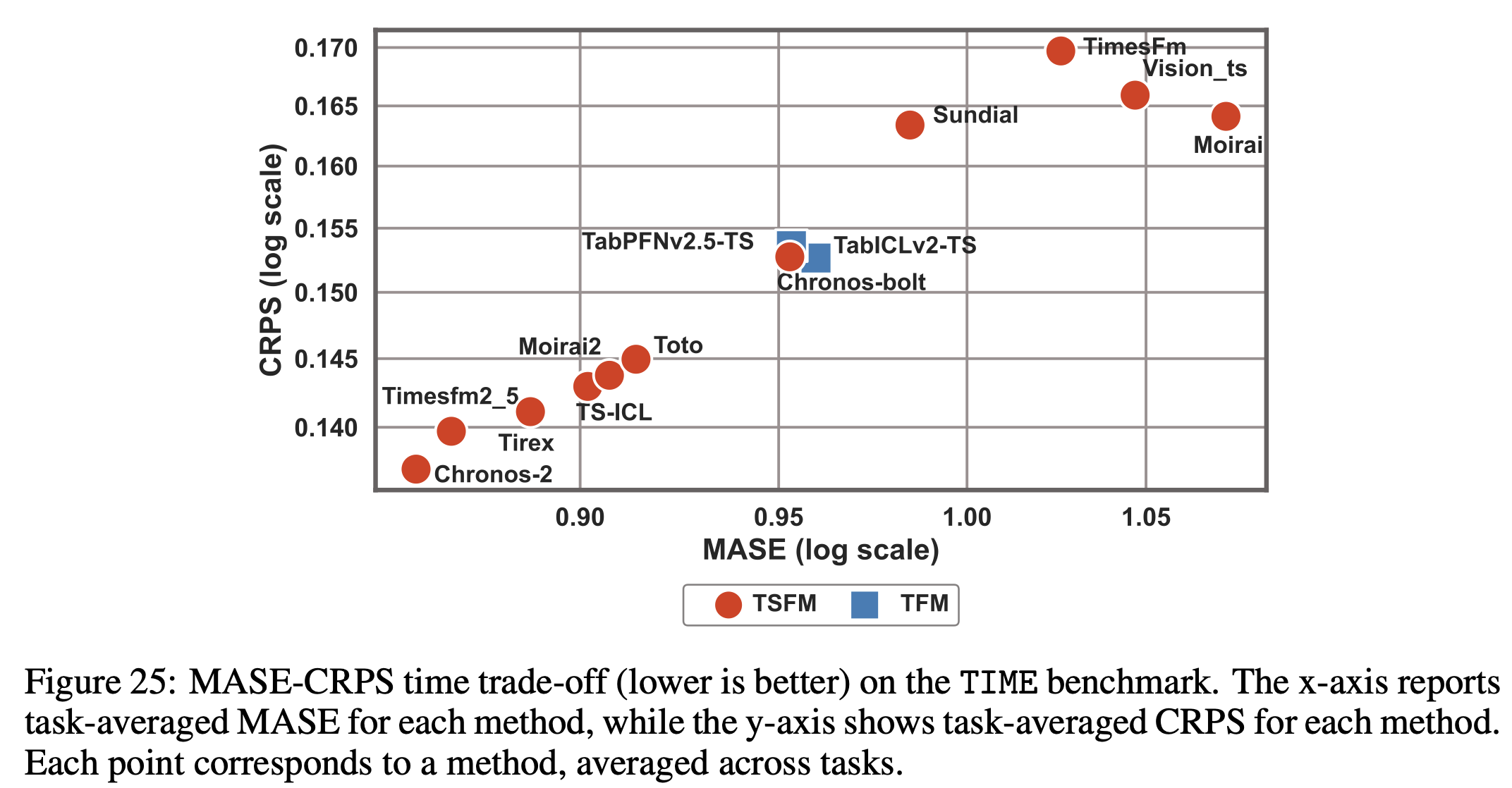
TIME benchmark results#
Imputation — fm-impute-bench#
TS-ICL achieves state-of-the-art imputation across 132 univariate and 24 covariate-aware tasks, outperforming the best tabular foundation model baseline while being ~50× faster at inference.
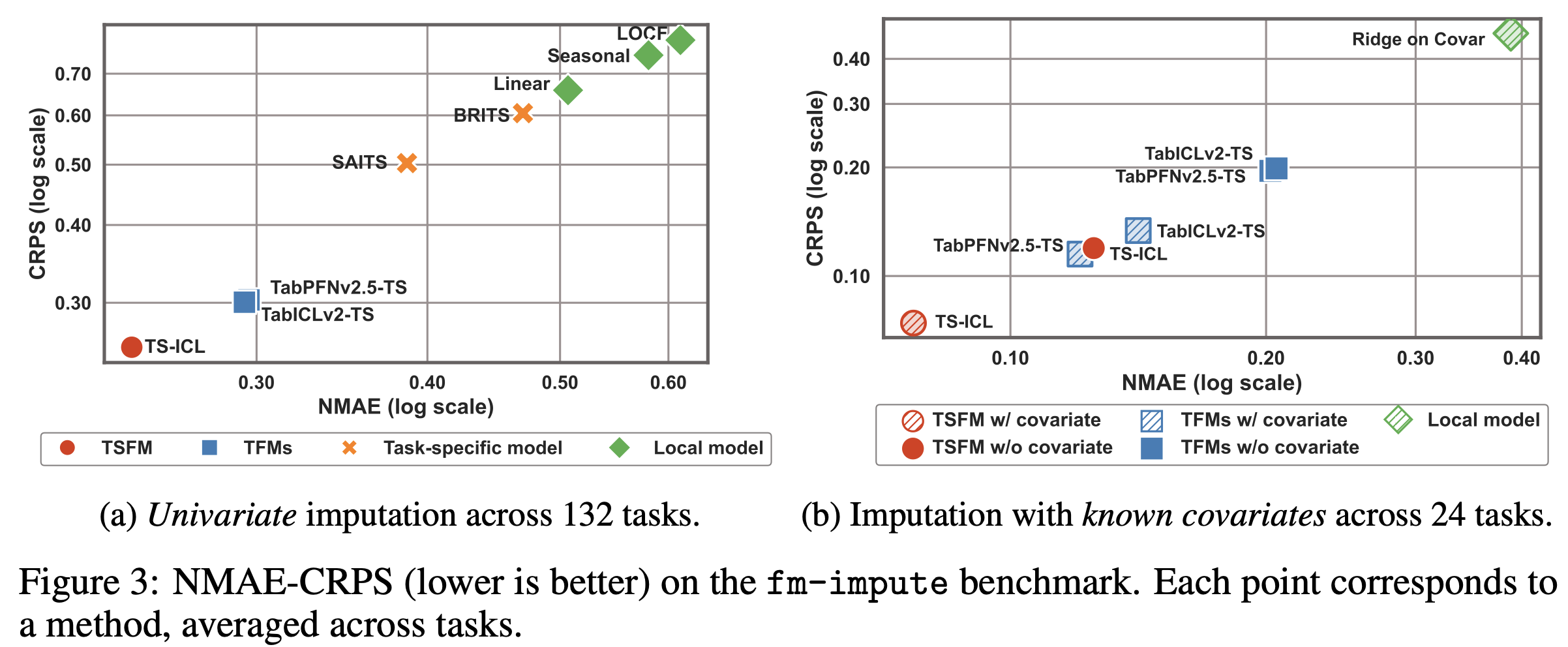
fm-impute-bench results#
Example — block imputation with uncertainty quantification (COVID-19 energy dataset):
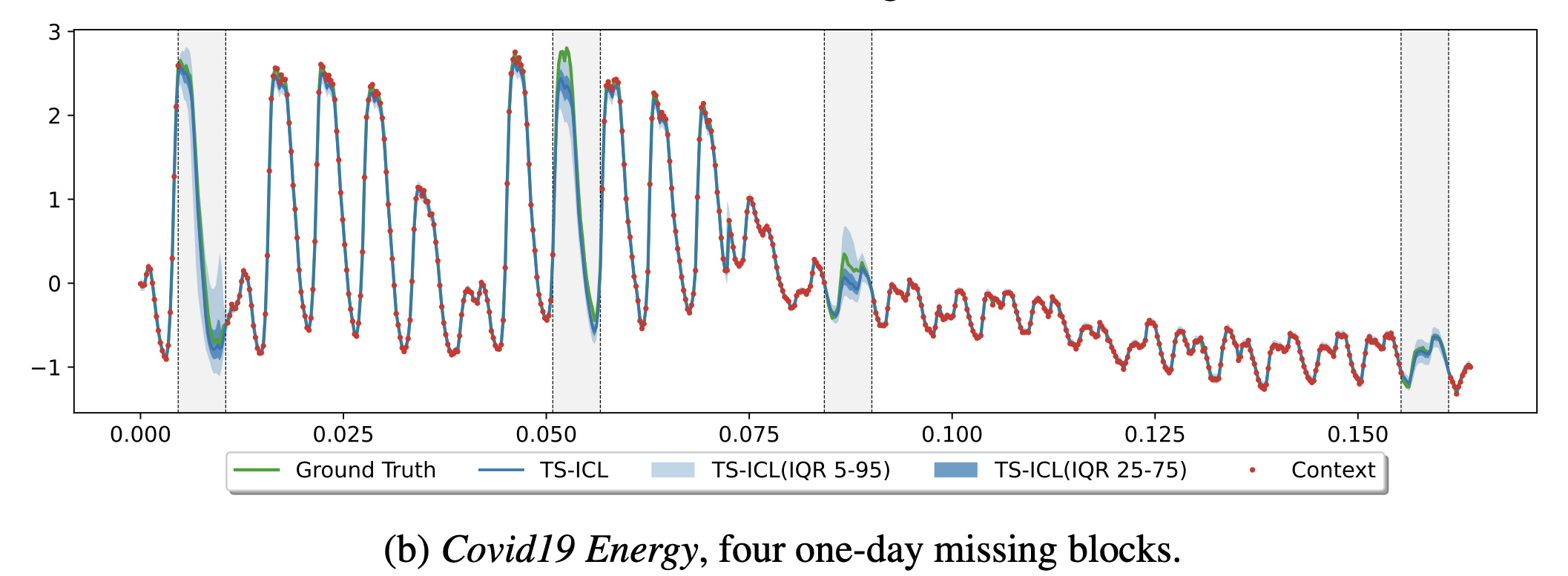
Block imputation with uncertainty quantification example#
Citation#
If you use TS-ICL for research purposes, please consider citing the associated paper:
@article{lenaour2026tsicl,
  title={TS-ICL: A Flexible Time-Indexed Foundation Model for Time Series via In-Context Learning},
  author={Le Naour, Etienne and Nabil, Tahar and Petralia, Adrien},
  journal={arXiv preprint arXiv:2606.05878},
  year={2026}
}
Contributors#
License#
TS-ICL weights and code are released under a non-commercial license, see LICENSE.
Contact#
To learn more or request a commercial license, please contact us at:
tsicl-contact_at_edf.fr (replace _at_ with @).